

Liquid Cooling for Edge AI: Overcoming Thermal Throttling in Mission-Critical AI Systems
Why traditional air cooling is reaching its limits and how phase-change liquid cooling enables sustained AI performance at the edge
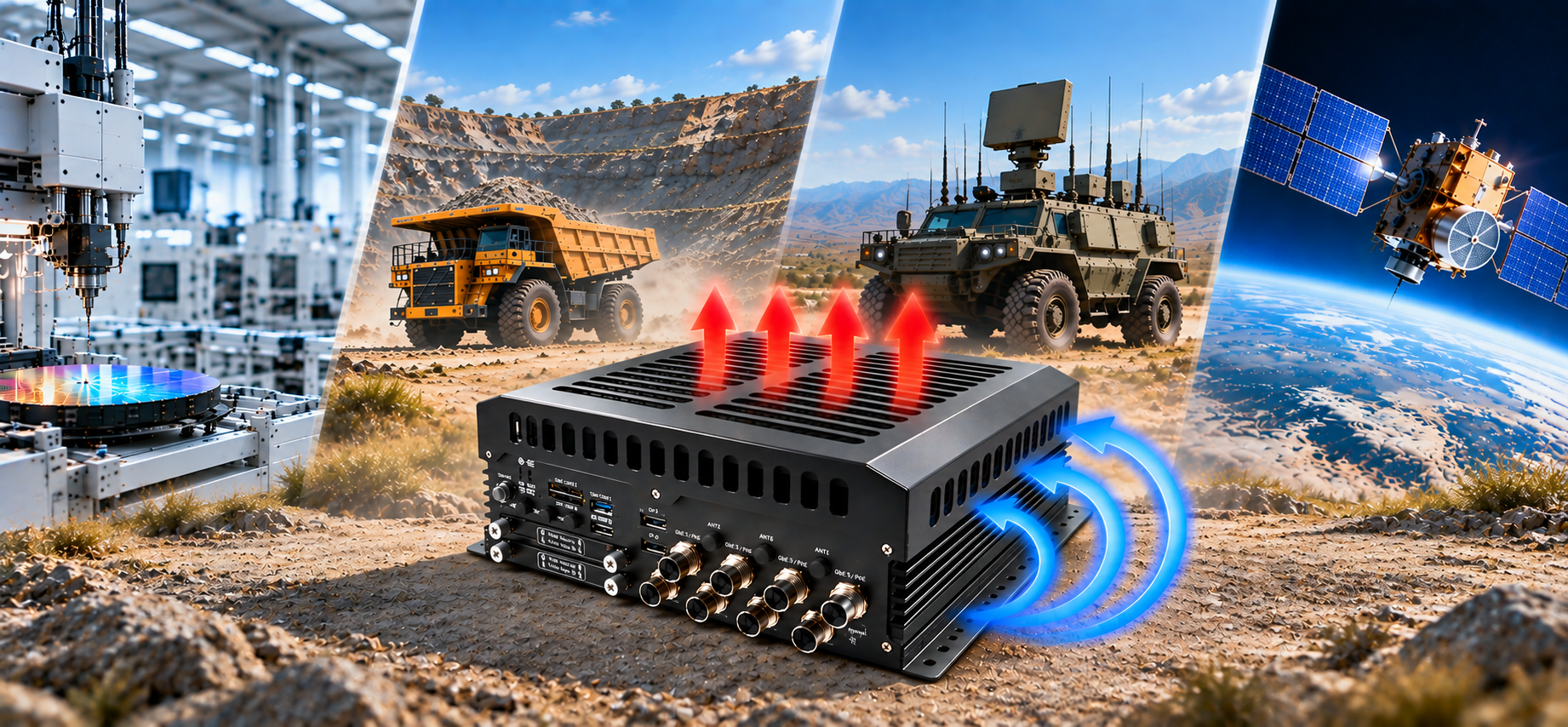
You’ve optimized every configuration file and tuned the software stack. Yet under sustained AI workloads, performance can still decline, not because of inefficient code, but because CPUs and GPUs have reached their thermal limits. This condition, known as thermal throttling, automatically reduces processor performance to prevent overheating.
In mission-critical edge AI systems, thermal throttling can mean higher inference latency, reduced processing throughput, and less predictable system performance. Applications such as AI‑powered Automated Optical Inspection (AOI) Autonomous Mobile Robots (AMRs) , Unmanned Ground Vehicles (UGVs), and multi-camera machine vision share one demand: sustained, predictable reliability.
Why Edge AI Is Creating a New Thermal Challenge
As artificial intelligence advances, industries are racing to deploy hardware closer to data sources to reduce latency and process more data locally. This shift also concentrates greater computing power and therefore more heat into compact industrial systems. Three trends are accelerating this challenge:
- Graphics-intensive workloads: Real-time computer vision, sensor fusion, and multi-camera analytics require sustained CPU and GPU processing.
- Localized AI processing: Factories, vehicles, and mission-critical systems often process data locally because of latency, connectivity, privacy, or cybersecurity requirements.
- Advanced applications: Digital twins, physical AI, autonomous systems, and high-resolution machine vision are increasing compute density at the edge.
Even embedded GPUs are moving into higher thermal envelopes. For example, NVIDIA RTX™ Embedded Ada Generation GPUs can operate at up to 150W, illustrating the thermal challenge of bringing high-performance GPU computing into compact edge systems.
Liquid Cooling Is Growing in Data Centers — But Edge AI Is Different
AI has already changed cooling strategies in high-density data centers. As GPU and rack power densities increase, direct liquid cooling (DLC), cold plates, and immersion cooling are gaining adoption for AI and high-performance computing infrastructure.
However, liquid cooling has not replaced air cooling across the data center industry. The Uptime Institute Cooling Systems Survey found that perimeter air cooling remained the most widely used approach, while direct liquid cooling was used by 22% of surveyed organizations responding to this question. Higher rack densities were the leading driver of DLC adoption.
The thermal challenge is now extending from centralized AI infrastructure toward the edge, but data-center cooling architecture cannot simply be transferred to industrial edge systems.
Since the physical environments of data centers and edge nodes differ, edge AI computers may operate inside factories, trains, autonomous vehicles, robots, heavy-duty off-highway vehicles, ITS roadside infrastructure, or defense platforms, where space, power, vibration, dust, and maintenance access are tightly constrained.
The challenge therefore becomes: How can system designers bring liquid-cooling-class thermal management to the edge without bringing data-center cooling infrastructure with it?
Why Conventional Liquid Cooling Does Not Simply Translate to the Edge
Two common data-center liquid cooling approaches illustrate the challenge:
- Immersion cooling: Entire systems are submerged in dielectric fluid for highly effective heat removal. However, immersion requires specialized infrastructure, fluid handling, and maintenance procedures that are difficult to replicate in distributed edge deployments.
- Direct-to-Chip (DTC) cooling: Cold plates transfer heat directly from high-power processors such as CPUs and GPUs. DTC is well suited to high-density servers but typically depends on pumps, coolant distribution, or supporting facility infrastructure.
Phase-Change Liquid Cooling: A Self-Contained Approach for Edge AI
One emerging approach is self-circulating phase-change liquid cooling, which transfers heat through a sealed cooling loop without requiring mechanical pumps. This method uses a pumpless siphon loop to transfer heat through sealed enclosures with aluminum extrusion. SINTRONES’ patented ThermoSiphon™ cooling technology uses natural thermodynamic forces, including phase change, pressure differences, and gravity, to circulate refrigerant between heat-generating components and the system enclosure. Unlike conventional fan cooling, the architecture requires no cooling fan or pump.
A multi-layer cold plate, working in tandem with thermal interface materials (TIMs), ensures direct contact with hot spots across the entire mainboard, enabling uniform heat dissipation. Because the cooling medium remains inside a sealed loop, the system does not require external coolant infrastructure or routine coolant handling during normal operation. This architecture fills an important gap between traditional passive cooling and infrastructure-dependent data-center liquid cooling.
What Are the Benefits of Phase-Change Liquid Cooling for Edge AI?
- Sustained AI Performance
Efficient heat transfer helps reduce the risk of CPU and GPU thermal throttling during continuous AI inference, computer vision, and sensor-processing workloads, improving performance consistency over extended operation. - No Cooling Fans or Pumps
A self-circulating design eliminates mechanical fans and pumps from the cooling loop. Fewer moving parts can reduce mechanical failure points, maintenance requirements, acoustic noise, and cooling-related power consumption. - Full-Coverage Thermal Management
Instead of concentrating cooling only on the CPU or GPU, full-board thermal management helps address localized hot spots across high-performance edge AI systems. - Closed-Loop Sustainability
The sealed cooling architecture uses a self-circulating phase-change process to transfer heat without a dedicated mechanical pump. Because coolant circulation is driven by thermodynamic forces rather than powered pumping, the design reduces the additional energy and infrastructure typically associated with conventional liquid-cooling systems. - Edge-Ready Reliability
Fanless cooling can help reduce the intake of dust and particulates, while a self-contained architecture eliminates dependence on facility-level liquid-cooling infrastructure. This makes the approach particularly relevant for factories, vehicles, transportation systems, autonomous machines, and other demanding edge environments.
Conclusion
As AI computing moves from centralized infrastructure toward factories, vehicles, robots, and other distributed systems, thermal management is becoming a critical part of edge AI system design.
Data centers are increasingly adopting liquid cooling to manage high-density AI workloads, but industrial edge systems require a different approach. Self-contained phase-change cooling brings the thermal advantages of liquid cooling to compact edge platforms without requiring pumps, cooling towers, or external coolant infrastructure.
System architects should evaluate cooling strategies early in the design process, aligning thermal loads with space availability, power budgets, and resource constraints and considering GPU performance, AI workload, ambient temperature, enclosure design, and maintenance requirements. The objective is not simply to keep processors cool, but to maintain predictable AI performance throughout the deployment lifecycle.
Key Takeaways:
- Higher AI compute density is increasing thermal challenges at the edge.
- Liquid cooling is gaining adoption in high-density AI data centers, but traditional data-center architectures are difficult to deploy at the industrial edge.
- Self-circulating phase-change cooling provides a compact, fanless, and pumpless alternative for high-performance edge AI.
- Full-board thermal management can help reduce thermal throttling and support sustained AI workloads.
- Cooling strategy should be evaluated early alongside AI workload, GPU selection, operating environment, and lifecycle requirements.
Planning a High-Performance Edge AI Deployment?
Explore the SINTRONES ABOX-5221(P)(G) LC Series or talk with our team about your GPU workload, thermal requirements, operating environment, and deployment constraints.