

How Edge AI Powers Vision-Based Navigation in Agricultural Robots
Rugged onboard computing for Vision AI, GPS tracking, and connected autonomous farming systems.
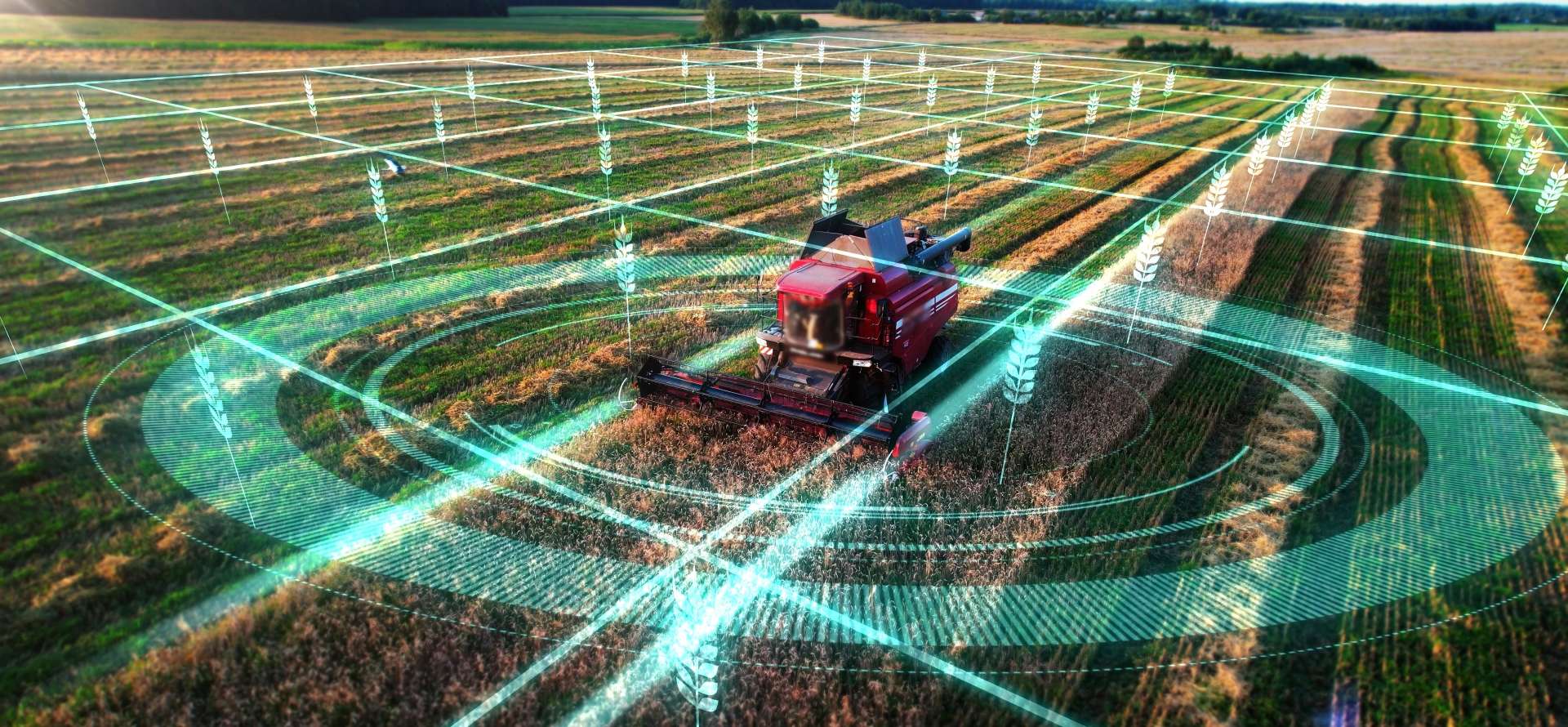
Autonomous agricultural robots rely on onboard computing to process camera and positioning data, support navigation, and maintain communication across agricultural fields. In this project, the customer selected the SINTRONES IBOX-601-G2, powered by NVIDIA Jetson Orin NX, as the edge AI computing platform for an autonomous farming robot. The solution provides the processing performance, camera interfaces, and connectivity needed to integrate Vision AI software, GPS tracking, and remote monitoring capabilities in demanding outdoor environments.
Application Overview
|
Application |
Autonomous agricultural robot for precision agriculture |
|
Challenge |
AI image recognition, precise motor control, GPS tracking, and reliable outdoor connectivity |
|
Edge AI Computer |
SINTRONES IBOX-601-G2 |
|
AI Platform |
NVIDIA Jetson Orin NX |
|
Camera Support |
Up to 4× GMSL-2 cameras via FAKRA connectors |
|
Connectivity |
Dual M12 Ethernet, LTE and GPS expansion |
|
Deployment Environment |
Outdoor agricultural fields with dust, moisture exposure, and vibration |
|
Key Benefits |
Vision AI-driven navigation support, remote fleet monitoring, and rugged onboard computing |
What Challenges Do Autonomous Agricultural Robots Face in the Field?
Autonomous agricultural robots must coordinate image recognition, positioning, and motor control as they move through crop fields. For this project, the customer needed a computing platform capable of supporting Vision AI workloads while integrating with the robot’s navigation and control systems.
Cameras were required to capture visual information for AI image recognition, while GPS tracking provided location data. These inputs needed to work alongside the robot’s control system to support autonomous crop navigation. Reliable LTE communication was also essential for remote monitoring and maintaining connectivity with deployed robots.
Beyond computing performance, the onboard system had to operate under the vibration and changing conditions of agricultural environments, where dust, moisture, and variable power conditions can create additional deployment challenges.
How Do Vision AI and GPS Support Agricultural Robot Navigation?
Vision AI and GPS provide complementary information for autonomous agricultural navigation. Cameras capture visual data from the field, while AI software processes the images to support recognition of relevant agricultural surroundings. GPS supplies positioning information that can be used for location tracking and navigation-related functions.
In an integrated robotic system, these inputs can be combined through navigation algorithms and control software to coordinate movement through crop fields.
The navigation process involves four key functions:
- Visual Data Capture: Cameras collect images of the surrounding agricultural environment.
- Vision AI Processing: AI software analyzes camera data onboard to support image recognition.
- GPS Positioning: GPS provides location information for tracking and navigation-related processing.
- Navigation and Motor Control: The robot’s navigation software and control systems use relevant information to coordinate movement.
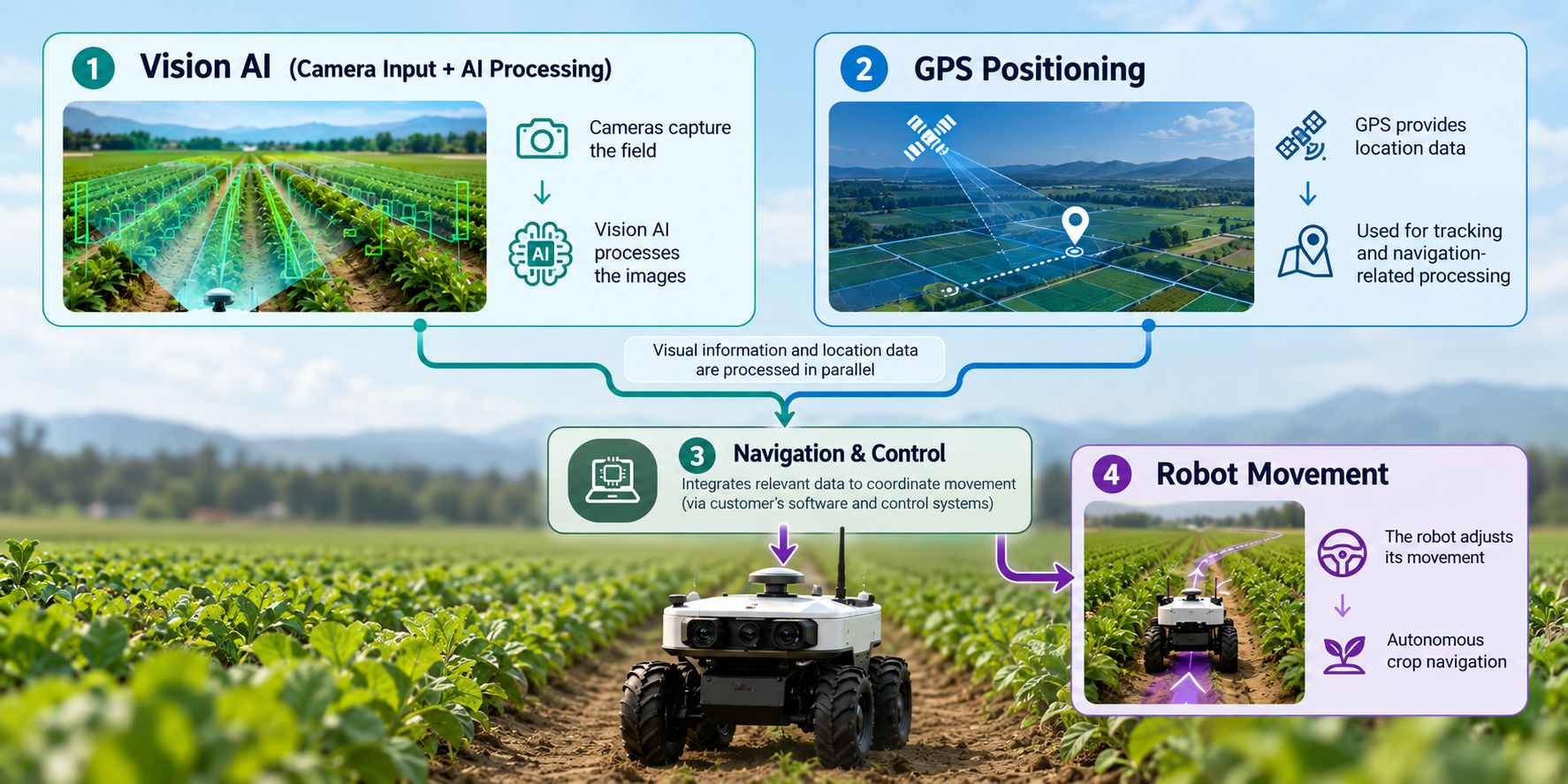
By processing camera data locally, the robotic system can support time-sensitive navigation functions without relying on continuous cloud connectivity. The specific recognition, navigation, and control functions depend on the AI software and robotic system architecture.
Why Use a Rugged Edge AI Computer for Agricultural Robots?
An edge AI computer provides the onboard processing resources and connectivity required to integrate cameras, positioning systems, and navigation-related software. Rather than sending time-sensitive visual data to remote servers, agricultural robots can run AI inference locally while maintaining wireless connectivity for remote communication.
For this project, the customer selected the SINTRONES IBOX-601-G2, a fanless edge AI computer powered by NVIDIA Jetson Orin NX. The platform supports up to four GMSL-2 cameras through FAKRA connectors, providing high-bandwidth camera interfaces for multi-camera Vision AI applications.
Dual M12 X-coded Ethernet ports provide robust wired network connectivity, while expansion options for LTE and GPS modules support wireless communication and location tracking. These capabilities provide the hardware foundation for integrating sensor data and supporting navigation-related processing through the customer’s software and control systems.
Designed for mobile deployments, the IBOX-601-G2 also features a 9–60V DC input with smart power management, fanless cooling, and vibration-tested construction. Its rugged design helps address the power, connectivity, and mechanical demands of agricultural robotic equipment operating in the field.
Bringing Edge AI to Precision Agriculture
By integrating onboard AI computing with camera inputs, positioning, and communication capabilities, the agricultural robot can support autonomous field operations while providing operators with remote visibility into deployed equipment.
For the customer, the solution offers three key benefits:
- Vision AI-Driven Navigation Support: NVIDIA Jetson Orin NX provides onboard processing resources for AI image recognition, enabling navigation-related software to use visual information from the field.
- Remote Fleet Monitoring: LTE communication and GPS tracking support remote access to robot location and operational information through an integrated monitoring system.
- Rugged Field Reliability: Fanless cooling, M12 connectivity, wide-range DC power input, and vibration-tested construction support deployment on mobile agricultural equipment.
The SINTRONES IBOX-601-G2 provides a rugged computing foundation for integrating Vision AI, GPS tracking, and communication technologies into autonomous agricultural robots, supporting the continued adoption of edge AI in precision agriculture.
Frequently Asked Questions
How does an edge AI computer support autonomous agricultural robots?
An edge AI computer provides onboard processing resources for AI models, camera data, and sensor information. When integrated with appropriate AI software, navigation algorithms, and control systems, it supports real-time image recognition and autonomous navigation without relying on continuous cloud connectivity. The SINTRONES IBOX-601-G2 uses NVIDIA Jetson Orin NX to provide the computing foundation for these applications.
How do agricultural robots combine Vision AI and GPS for navigation?
Agricultural robots can combine camera-based image recognition with GPS positioning data to support navigation through crop fields. Vision AI software processes visual information, while GPS provides location data. Navigation algorithms and control systems can then use these inputs to determine movement commands. The exact integration depends on the robot’s software and system architecture.
What should I consider when choosing an edge AI computer for agricultural robots?
Key considerations include AI processing performance, camera interfaces, sensor connectivity, wireless expansion, power input, and environmental durability. For example, the SINTRONES IBOX-601-G2 combines NVIDIA Jetson Orin NX, support for up to four GMSL-2 cameras, dual M12 Ethernet, optional LTE/GPS expansion, and a rugged fanless design for mobile agricultural applications.
Why use edge AI instead of cloud computing for agricultural robot navigation?
Edge AI allows agricultural robots to process time-sensitive camera and sensor data onboard, reducing dependence on network connectivity for navigation-related decisions. Cloud computing can complement onboard processing for remote monitoring, fleet management, data storage, and software updates. This hybrid approach supports local AI processing while maintaining centralized visibility into deployed robots.
Building an Autonomous Agricultural Robot?
Developing an agricultural robot with Vision AI, GPS tracking, or multi-camera integration? SINTRONES offers rugged edge AI computing platforms designed for mobile applications. Talk to our team about your processing, connectivity, and deployment requirements.