

How Edge AI Powers Physical AI in Next-Generation Robotics
Industrial robotics is entering a new era. Traditional robots excel at repetitive, pre-programmed tasks. Physical AI is changing that model by enabling machines to perceive their surroundings, interpret real-world data, and respond to changing conditions in real time.
Across manufacturing, this shift is becoming increasingly visible in machine vision, autonomous mobile robots (AMRs), intelligent inspection, and adaptive automation. But bringing AI into the physical world creates a fundamental challenge: intelligence must operate at the speed of action.
Every camera frame, LiDAR point cloud, and sensor signal must be processed quickly enough to influence what a robot does next. This is where Edge AI becomes critical, bringing AI inference closer to the machine, where perception must become action in real time.
Why Physical AI Needs Edge AI
Modern industrial robots continuously generate and consume data from multiple sources:
Machine Vision Cameras: Inspection, identification, and robotic guidance
LiDAR and Radar: Mapping, ranging, and obstacle detection
IMU Sensors: Motion and spatial awareness
Industrial Sensors: Machine and environmental data
For robots operating in dynamic environments, this data must be processed fast enough to support immediate decisions.
Sending every raw data stream to the cloud can introduce latency, consume substantial bandwidth, and create dependency on network availability. Edge AI addresses these constraints by processing AI workloads locally, on or near the machine.
This allows robots to perform visual inspection, object recognition, navigation, and other time-sensitive AI tasks without relying on continuous cloud connectivity. Edge AI becomes the bridge between Physical AI perception and physical action.
From Sensors to Decisions: The Physical AI Data Pipeline
Physical AI requires more than AI inference. It depends on the ability to collect, process, and act on multiple streams of real-world data. An industrial Edge AI computer can serve as a sensor-fusion and computing hub, bringing together:
High-Speed Vision: GMSL2 and PoE for machine vision
Spatial Perception: LiDAR, radar, and IMU data for navigation
Industrial Communication: CAN Bus, EtherCAT, and connectivity to PLC-based systems
AI Acceleration: CPU, GPU, or dedicated AI accelerators for real-time inference
Processing these inputs locally allows intelligent machines to move through a continuous cycle:
Sense → Interpret → Decide → Respond
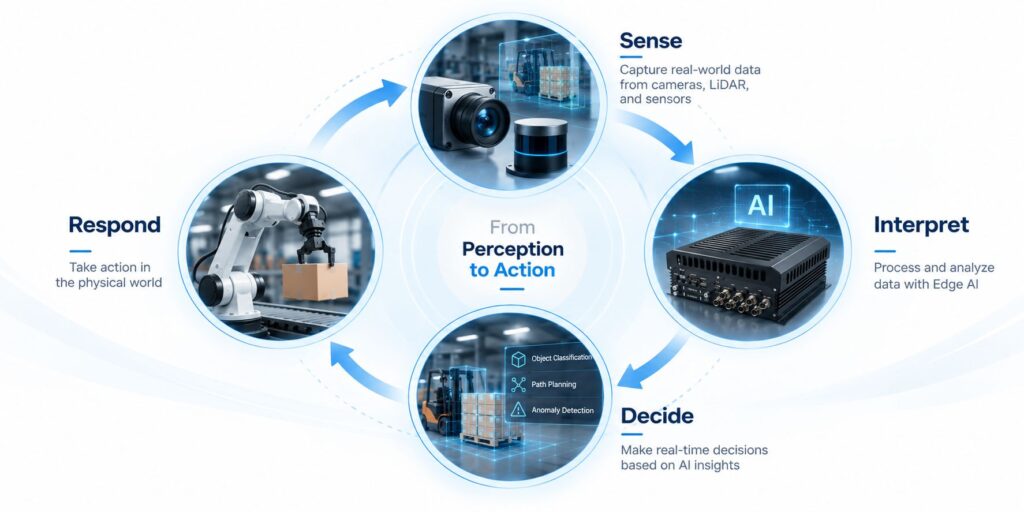
This is the foundation of Physical AI: turning real-world data into decisions quickly enough for machines to interact with changing physical environments.
Physical AI Requires Reliable Hardware
AI performance alone does not determine whether a robotic system can succeed in the real world. Unlike cloud infrastructure operating in controlled data centers, industrial robots may face vibration, temperature variation, electrical instability, dust, and continuous 24/7 workloads.
As a result, Physical AI computing platforms must address several requirements beyond raw AI performance:
|
Requirement |
Why It Matters |
|
Thermal Stability |
Maintains computing performance under sustained AI workloads |
|
Shock & Vibration Resistance |
Supports mobile robots and equipment exposed to movement |
|
Power Resilience |
Supports system stability during voltage fluctuations |
|
High-Bandwidth I/O |
Connects cameras, sensors, and industrial devices |
|
Industrial Connectivity |
Integrates AI with existing automation infrastructure |
|
Flexible Expansion |
Accommodates evolving sensors and AI accelerators |
These requirements are part of a broader challenge: ensuring edge AI hardware reliability as AI moves from controlled computing environments into real-world operations.
From Rugged Computing to Physical AI
As Physical AI expands across industrial automation, computing requirements traditionally associated with mission-critical applications are increasingly appearing on the factory floor. SINTRONES brings its experience in rugged edge computing to industrial AI deployments where AI performance must coexist with thermal stability, power resilience, industrial connectivity, and flexible expansion.
For compute-intensive machine vision, robotics, and autonomous applications, rugged Edge AI computers provide the processing performance and connectivity required to handle demanding real-time workloads. For compact and power-efficient robotics and vision systems, embedded Edge AI computers provide another approach to deploying AI inference directly at the point of operation. Together, these architectures bring AI closer to cameras, sensors, machines, and robotic systems, helping transform AI capability into real-world action.
The Future of Physical AI Starts at the Edge
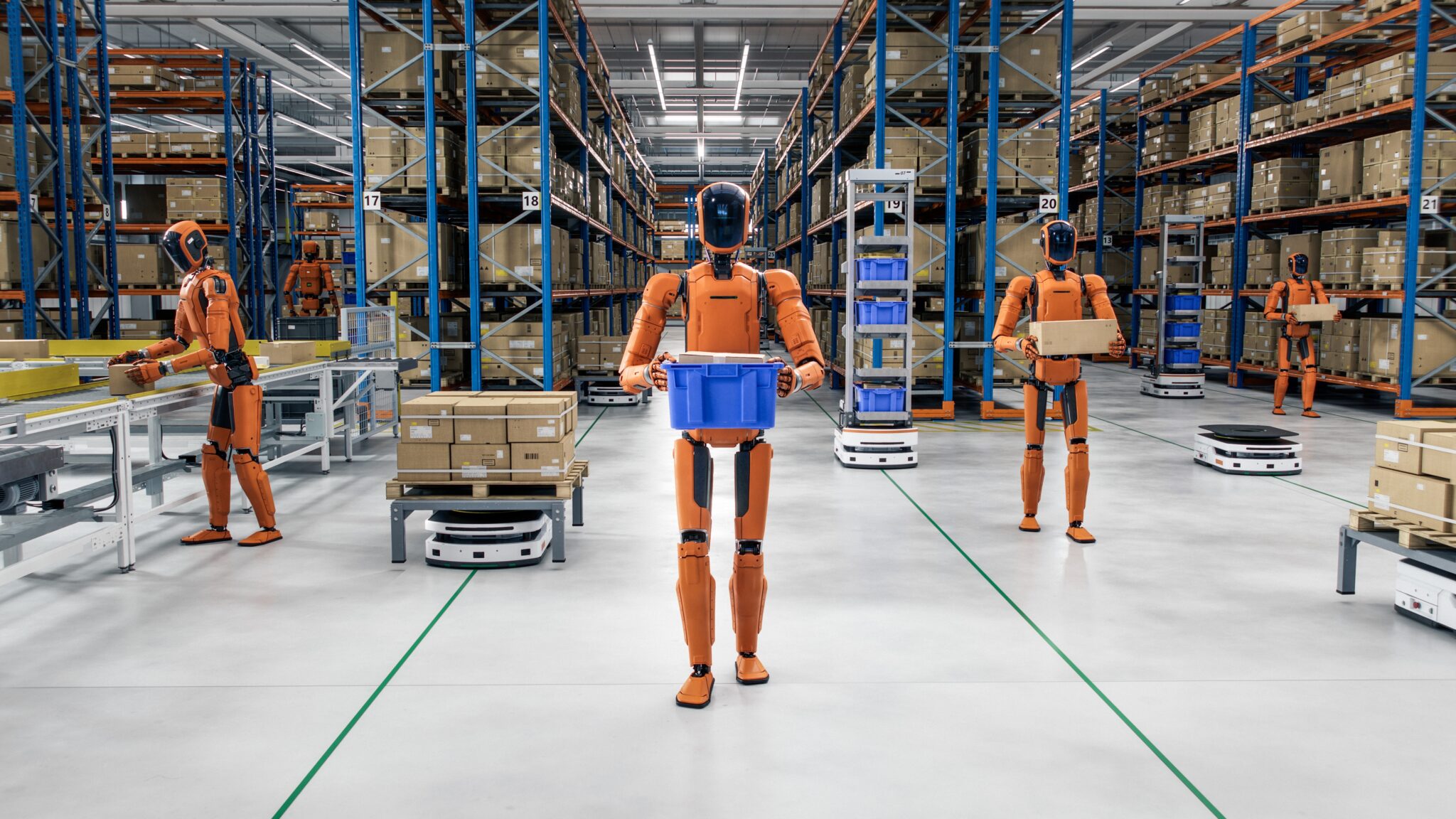
The next generation of robotics will not be defined by AI models alone. It will depend on how effectively intelligence can interact with the physical world. As robots gain more advanced perception, reasoning, and autonomy, computing must move closer to the cameras, sensors, machines, and actuators where decisions become actions.
The cloud can train intelligence. The edge is where intelligence acts. Edge AI provides the computing foundation that turns real-world data into immediate decisions, helping Physical AI move from concept to practical industrial deployment.
Frequently Asked Questions
What is Physical AI in industrial robotics?
Physical AI refers to AI systems that interact directly with the physical world. In industrial robotics, these systems use cameras, sensors, and other real-world data to perceive environments, make decisions, and control or influence machine behavior.
Why does Physical AI need Edge AI?
Physical AI often requires decisions to be made close to the machine. Edge AI processes vision, sensor, and operational data locally, reducing latency and dependence on cloud connectivity while enabling faster responses for machine vision, autonomous navigation, and other real-time robotic applications.
Can Physical AI operate without continuous cloud connectivity?
Yes. Edge AI allows many inference and decision-making workloads to run locally. Cloud platforms can still support model training, analytics, fleet management, and software updates, while time-sensitive robotic functions continue operating at the edge when network connectivity is limited or unavailable.