

Onboard Computer and Fleet Management Solutions for Emergency Connectivity
Learn how the SINTRONES VBOX-3630 helped Madrid emergency services maintain reliable onboard communications, continuous fleet connectivity, and uninterrupted access to mission-critical information.
 Case Overview

|
Industry |
Emergency Services |
|
Application |
Emergency Fleet Connectivity |
|
Location |
Madrid, Spain |
|
Challenge |
Reliable onboard communications in high-mobility emergency vehicles |
|
Solution |
VBOX-3630 rugged onboard computer |
|
Outcome |
Stable fleet connectivity, reliable dispatch communications, and continuous access to mission-critical information |
Emergency Response Depends on Reliable Connectivity
Every emergency response begins with information. Whether dispatching an ambulance, coordinating fire services, or directing law enforcement, emergency vehicles must remain continuously connected to the control center while accessing navigation, incident updates, and operational data in real time.
As cities become increasingly connected, emergency fleets are expected to exchange more information than ever before. However, maintaining reliable communications in high-mobility environments remains a significant challenge. Frequent engine starts, unstable vehicle power, continuous vibration, and changing network conditions can all interrupt onboard systems, reducing operational efficiency when every second counts.
For emergency service operators, dependable onboard computing is no longer simply an IT requirement—it has become a critical component of public safety.
Operational Challenges for Emergency Vehicle Systems
A leading emergency service operator in Madrid planned to upgrade its fleet communication infrastructure by integrating dispatch terminals and high-precision GPS tracking across its emergency vehicles.
The deployment required a computing platform capable of supporting continuous mobile operations while maintaining reliable access to mission-critical information throughout daily emergency response.
Key operational requirements included:
- Reliable communication between vehicles and the dispatch center
- Stable onboard computing during continuous vehicle operation
- Real-time access to dispatch information and navigation
- Support for wireless communication and GPS positioning
- Reliable operation despite vibration, temperature variation, and vehicle power fluctuations
Why Conventional Vehicle Computers Fall Short
Traditional commercial computers are rarely designed for the realities of emergency vehicle operations.
Unlike fixed industrial environments, emergency fleets operate under constant movement, repeated engine ignition cycles, unstable power conditions, and demanding environmental factors. These conditions can affect system availability, increase maintenance requirements, and interrupt access to critical operational information.
For emergency fleets, reliable communications depend not only on wireless networks but also on computing platforms specifically engineered for continuous vehicle deployment.
An Onboard Computer Built for Fleet Connectivity
To support reliable fleet communications, the operator deployed the SINTRONES VBOX-3630, a rugged onboard computer designed for transportation applications.
Designed specifically for vehicle environments, the VBOX-3630 combines a 9–60V wide-range DC power input, vehicle power ignition, configurable power-off delay, and automatic short-circuit protection to help maintain stable operation during frequent vehicle start-up and shutdown cycles. An optional battery backup kit can further support temporary operation during brief power interruptions.
To simplify mobile system integration, the platform supports optional 5G/LTE, Wi-Fi 6E, Bluetooth 5.2, and GPS modules, with dual SIM support for cellular connectivity, providing system integrators with flexible connectivity options for emergency fleet deployments.
Its rugged aluminum chassis supports operation from -40°C to 70°C and complies with E-Mark, along with transportation-related standards including EN 50155 and EN 45545-2 (R25), supporting long-term deployment in demanding vehicle environments.
Connected Vehicle System Integration
Serving as the onboard computing hub, the VBOX-3630 connects dispatch terminals, communication devices, and positioning systems into a unified mobile computing platform.
Typical System Architecture
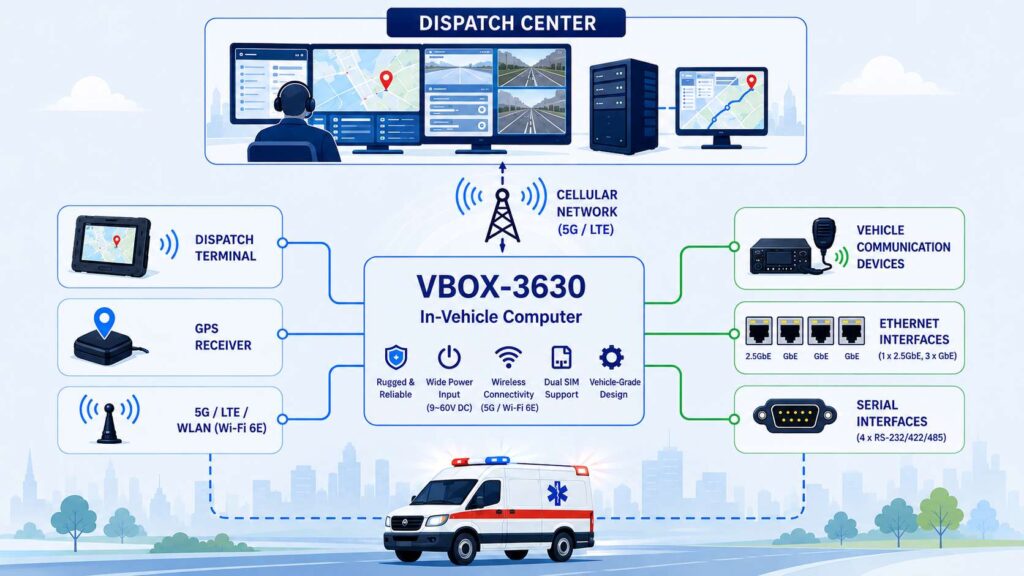
Its 1 × 2.5GbE and 3 × Gigabit Ethernet interfaces, four RS-232/422/485 serial ports, USB connectivity, digital I/O, and an optional mPCIe CAN Bus module provide the flexibility to integrate with a wide range of vehicle communication equipment and onboard subsystems.
Operational Impact
Deploying a rugged in-vehicle computing platform strengthened fleet communications while improving the reliability of daily emergency operations.
The solution helped operators achieve:
- Faster access to dispatch information during emergency response
- Improved fleet coordination through reliable vehicle connectivity
- Stable onboard operation despite vehicle power fluctuations
- Simplified integration with existing communication infrastructure
- Reliable computing performance for continuous public safety operations
Rather than simply adding computing power, the deployment established a dependable platform capable of supporting long-term fleet modernization initiatives.
Why SINTRONES
Mission-critical fleets require more than processing performance—they require computing platforms engineered for continuous operation in demanding vehicle environments.
With intelligent vehicle power management, flexible wireless expansion, transportation certifications, and rugged mechanical design, the SINTRONES VBOX-3630 delivers reliable onboard computing that helps emergency fleets stay connected, responsive, and ready for every mission.